
I am a third-year Ph.D. student in Molecular Sciences in the Department of Chemical Sciences at the University of Padova (Italy), under the supervision of Professor Cristina Peggion. My Ph.D. project is funded by the European Union – Next Generation EU and my research focuses on developing inhibitors of the West Nile virus (WNV) by targeting the viral NS2B–NS3 protease through two complementary strategies: inhibition of the active site and modulation of an allosteric pocket.
From September to November 2025, thanks to the support of the EPS Mobility Fellowship, I had the opportunity to conduct research at the Gulbenkian Institute for Molecular Medicine (GIMM) in Lisbon, under the guidance of Prof. Miguel Castanho, Dr. Marco Cavaco, and Dr. Vera Neves. Their group has extensive expertise in blood–brain barrier shuttle peptides (BBBpS) and in vitro blood-brain barrier (BBB) translocation assays, providing an ideal environment to advance my project and identify promising antiviral candidates that act on NS3 of WNV.
During my stay, I focused on evaluating both the cytotoxicity and BBB translocation ability of a selection of peptides, peptidomimetics, and peptide–BBBpS conjugate. I assessed the cytotoxicity of three different NS2B–NS3 protease inhibitors, one modified BBBpS, and one conjugate, generated by coupling a peptide inhibitor with one of the most promising BBBpS, across three different cell lines. In addition, I investigated the capacity of the modified BBBpS, the inhibitor peptide, and the conjugate to cross the BBB using a well-established human-based endothelial brain model that reliably mimics the physiological properties of the human barrier.
The compounds were tested on the three cellular lines: neuronal cells (SH-SY5Y), cerebral microvascular endothelial cells (HBEC-5i), and human fibroblast cells (HS68). Only the conjugate exhibited slight cytotoxicity, while the other compounds demonstrated very low cytotoxicity in cell viability assays. All the tested peptides and peptidomimetics showed promising results in translocation assays because they were all able to overcome the BBB by 40-70%, and the barrier remained intact after translocation.
This experience considerably broadened my scientific expertise, particularly in performing cellular assays and in the cellular biology field. Beyond the laboratory work, actively participating in group meetings, scientific discussions, and daily interactions within an international research environment strengthened both my scientific perspective and my communication skills.
I would like to express my sincere gratitude to the European Peptide Society (EPS) for supporting my research stay in Lisbon, and to Prof. Miguel Castanho and his team for their warm hospitality and guidance. I am truly grateful for this opportunity, and I also encourage early-career scientists to take full advantage of the EPS Mobility Fellowship, which offers an exceptional opportunity to gain international experience, expand scientific networks, and promote collaborations within the peptideresearch community.
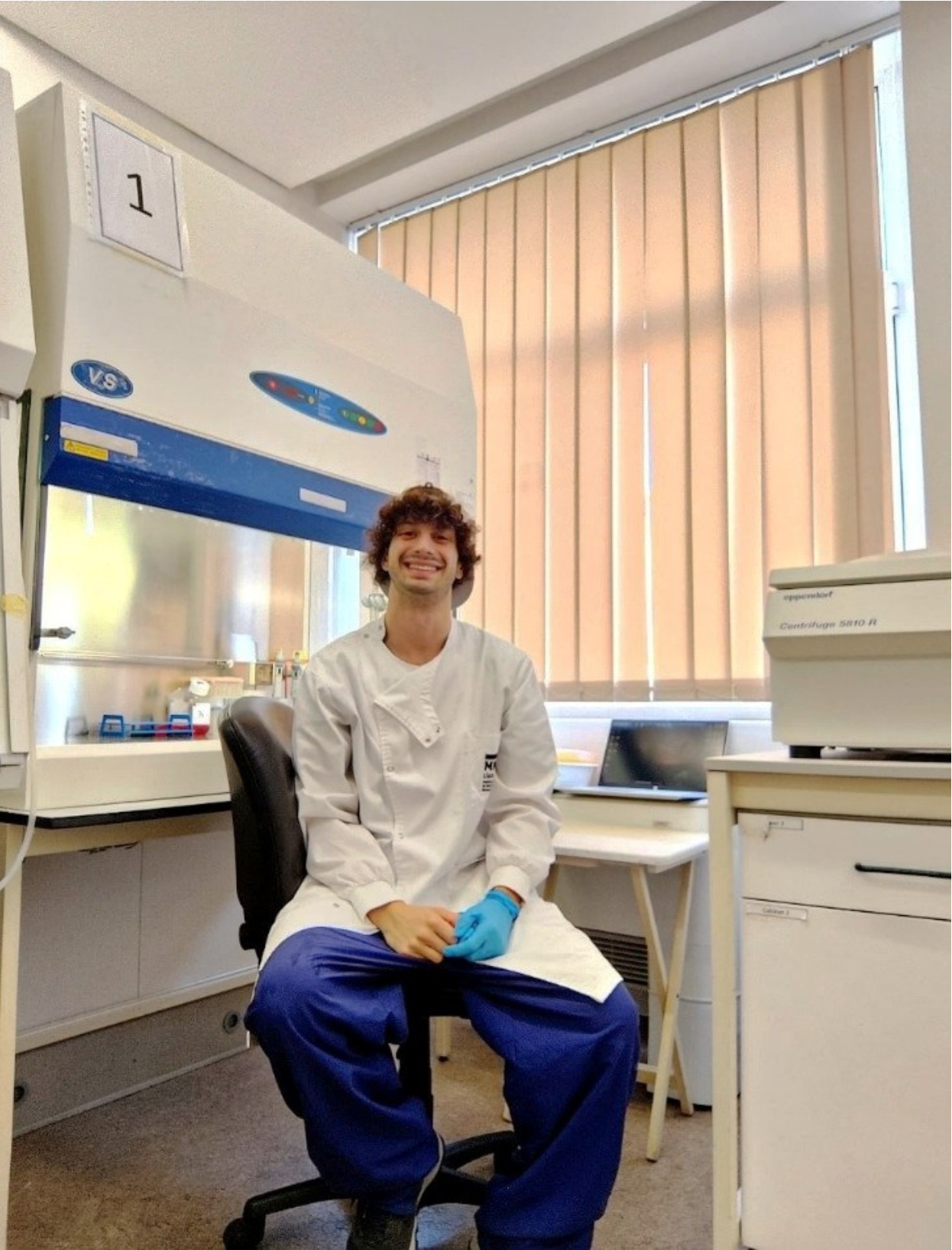
Daniele Volpin in the cell culture room performing cell viability and blood-brain barrier translocation assays.