I am a third year PhD student in the Peptidomimetics Group (supervised by Rosario González Muñiz and Diego Núñez-Villanueva) at the Medicinal Chemistry Institute (IQM-CSIC). My PhD research proposal is focused on cardiovascular peptides analogues of DECA-11, a peptide with significant antiarrhythmic activity and certain helical character. DECA-11 is a “difficult sequence peptide”, having required intensive synthetic optimization for linear analogues. Since cyclic peptides derivatives are able to stabilize α-helices and usually are more stable than linear sequences, we started working on the cyclization of DECA-11 peptides through side-chain to side-chain amide bond formation (i to i+4). However, the synthesis of these cyclic peptides revealed highly challenging.
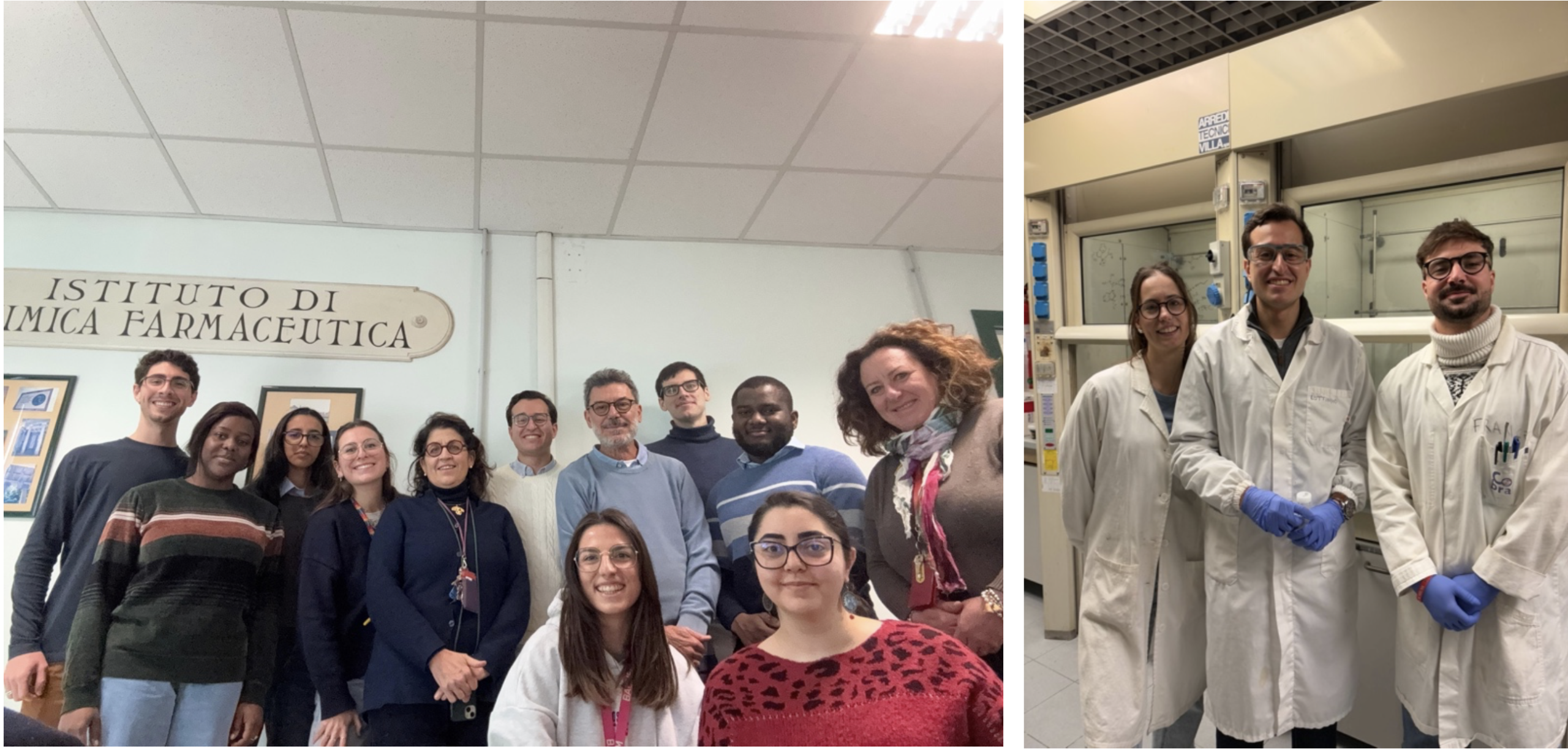
Thanks to the support of an EPS Mobility Fellowship, I was able to spend 3-months abroad, from mid September to mid December 2025 at the Interdepartmental Research Unit of Peptide and Protein Chemistry and Biology (PeptLab), Departments of Chemistry “Ugo Schiff” and “NeuroFarBa” of the University of Florence.
To overcome the issues with side-chain to side-chain amide cyclic peptides, we proposed a short stay there to prepare smart related triazolyl-bridged peptides using click chemistry approaches, given the expertise of Prof. Papini’s group. The 1,4-disubstituted 1,2,3- triazolyl bridge fragment, which is isosteric to the lactam bridge, is also inert toward an expansive variety of synthetic conditions and its proteolytic stability is highlighted for biological applications.
To this aim, I synthesized 8 cyclic peptides analogues of DECA-11 by click cyclization using Prof. Papini´s group methodology. First, we seeked the cyclization i to i+4 aiming to keep inside the cycle some key residues for activity. We also managed to explore the cyclization from i to i+7 for obtaining a bigger size cycle, which could allow higher motion of these key residues. Moreover, we wanted to study the conformational differences of both cycles and the corresponding two regioisomers.
The old issues found during cyclization step were solved by performing click reaction on solution which allowed us to achieve the stapled peptides in good crude purity. After purification cyclic peptides were finally achieved in purity of >95% and the characterization was made by HPLC- MS. Acetyl derivatives were studied by circular dicroism. Preliminary conformational studies suggest an enhanced degree of helicity in water of cyclic peptides (i to i+4) compared to linear sequences, meanwhile bigger triazolyl-bridged analogues (i to i+7) apparently exhibit lower helical character compared to peptides (i to i+4).
At my back to the Medicinal Chemistry Institute in Madrid, the compounds recently synthesized will be tested for their metabolic stability in human serum and liver microsomes, and for their conformational behavior in NMR, in collaboration with Prof. Jiménez (IQFBC, Madrid). Palmitoyl derivatives will also be evaluated for the biological activity by our collaborators at the Universidad Complutense (Madrid, Spain).
During my traineeship at the University of Florence within a top-tier research environment as “PeptLab”, I completed the work and considerably advanced my research. Furthermore, I also acquired valuable knowledge in automated synthesis of peptides using different equipments, and I have improved my skills in the manual SPPS and in-solution synthesis, specially performing the click stapling using the group´s methodology.
Finally, I would like to thank the EPS for the fellowship giving me the financial support to undertake my PhD stay abroad. I also thank to my PhD supervisors Prof. Rosario González and Dr. Diego Núñez for the proposal and guidance. I would like to express my honest gratitude to Prof. Anna Maria Papini and Prof. Paolo Rovero for the host supervision and the great opportunity of working in the “PeptLab”. Last but not least, I feel deeply grateful to every member of PeptLab, all the colleagues, one by one. I learned a lot from them, and they made me feel at home. It was an extraordinary experience for my personal and professional development, I really enjoyed it. I highly recommend joining the PeptLab, for the good atmosphere, for the high scientific level, for their commitment to peptides and to green chemistry research. I honestly encourage young researchers to take up an internship abroad and apply for an EPS fellowship.