
CONFERENCE REPORT
2nd EPS Peptide Highlights
Virtual Symposium, 2 March 2022

The 2nd EPS Peptide Highlights, held on 2 March, focused on “Peptide-based approaches to fight crop diseases” and covered topics such as functional and cyclic peptides to combat plant pathogens, and venom-derived peptides as bio-insecticides. Speakers were Volker Herzig from the University of the Sunshine Coast and Stefano Rosa from the University of Milan. The keynote lecture was given by Emílio Montesinos from the University of Girona. The symposium was moderated by Cátia Teixeira from the University of Porto and was supported by Ruben Ragg and Paolo Rovero the Editors-in-Chief of ChemBioChem and the Journal of Peptide Science, respectively.
The EPS Peptide Highlights Virtual Symposium opened with a welcome session by EPS Chair Norbert Sewald. Volker Herzig, who holds the position of Associate Professor, gave the first talk. His research focuses on the biodiscovery of novel arthropod venom components, particularly peptides, for potential, selective, and environmentally safe bio-insecticides. In his talk entitled “The search for arachnid venom-derived peptides as eco-friendly bio-insecticides”, he explained why arthropod venoms are a great source for novel bio-insecticides and presented some examples from his group of research with emphasis on Spear® – the first spider-toxin bio-insecticide on the market. Volker Herzig’s talk was followed by Stefano Rosa, a Ph.D. student at the FruitTOP Lab led by Dr. Simona Masiero at the Department of BioSciences of the University of Milan. His work is focused on the peptide aptamers identification from combinatorial libraries and their application for sustainable agriculture. In his talk entitled “An in vivo platform for the isolation of cyclic peptides with antimicrobial activity toward plant pathogens”, he presented an overview of his work with combinatorial libraries of cyclic peptides and their use to identify novel antimicrobial peptides as safer alternatives to some polluting fungicides. Emílio Montesinos is one of the world’s leading scientists in the field of antimicrobial peptides development as biopesticides, contributing to an integrated approach to control fruit tree diseases. In his outstanding keynote lecture on “The potential of functional peptides for the control of emerging diseases caused by plant pathogenic bacteria”, which closed this event, he presented his latest research on natural-based antimicrobial, plant elicitors, and multi-functional peptides to fight Xylella fastidiosa, a plant pathogen that has been devastating olive trees for over a decade.
This 2nd edition of the EPS Peptide Highlights was a great success with ~70 participants. The talks were very interesting and engaging and, although the topic of this virtual event was a very timely subject, it is also a subject, which is usually not considered to be the focus of peptide science, but it was evident that there are many promises in the application of peptides in fighting crop diseases. The problem of peptides’ large-scale production and inherent costs was also discussed with emphasis that, in addition to the traditional methodologies used, i.e. fermentation and recombinant plants, synthetic large-scale preparation of peptides is growing fast and presenting interesting opportunities.
We look forward to the next edition of the EPS Peptide Highlights Virtual Symposium!
Contributed by Cátia Teixeira
Online version of 2nd EPS Peptide Highlights Virtual Symposium “Peptide-based approaches to fight crop diseases”: https://youtu.be/3boVBlcZnQY

Moderators and supporters of the 2nd EPS Peptide Highlights Virtual Symposium (first row: Norbert Sewald, chair of the EPS; Ruben Ragg, editor-in-Chief of ChemBioChem; second row: Paolo Rovero, editor-in-Chief of the Journal of Peptide Science; Cátia Teixeira, Porto University).
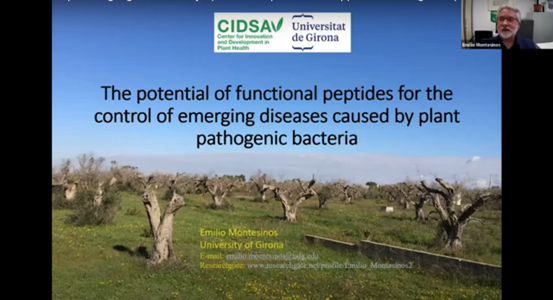
Keynote lecture by Emílio Montesino presenting his latest research on natural-based antimicrobial, plant elicitors, and multi-functional peptides to fight Xylella fastidiosa.
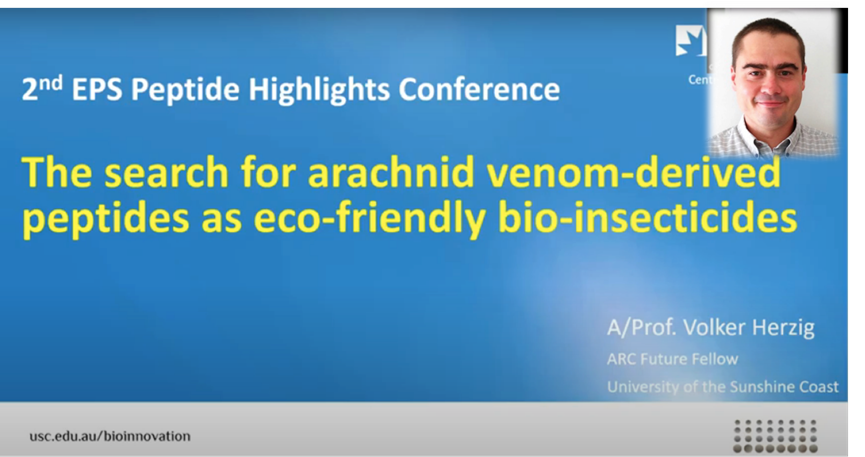
Volker Herzig presents his work on the biodiscovery of novel arthropod venom-based peptides for potential, selective, and environmentally safe bio-insecticides.
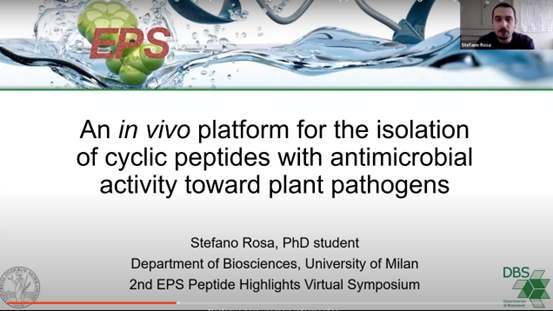
Stefano Rosa presents his work on peptide aptamers identification from combinatorial libraries and their application for sustainable agriculture.