
I’m a 3rd year PhD student in Biochemistry at the Department of Biochemical Sciences of the University of Rome “La Sapienza” (Italy) under the supervision of Prof. Maria Luisa Mangoni.
My PhD project is founded by the European Union and focuses on the investigation of innovative approaches to identify and optimize new therapeutic agents, with particular emphasis on antimicrobial peptides, for the treatment of infectious and genetic diseases, such as cystic fibrosis.
Amphibian skin secretions represent one of the most abundant natural reservoirs of antimicrobial peptides. Among these, esculentin peptides, isolated from the skin of the frog Rana esculenta, are known for their potent antimicrobial activity, by a membrane-perturbing mechanism of action. Notably, a peptide named Esc(1-21) has been extensively studied in the past in our lab and remains a subject of ongoing research. This peptide has shown significant antimicrobial activity against Gram-negative bacteria, such as Pseudomonas aeruginosa, but exhibits limited effectiveness against Gram-positive bacteria. However, strategic amino acid substitutions in the primary structure (in position 8) of Esc(1-21) with a non-proteinogenic amino acid (α-aminoisobutyric acid) have led to the development of a novel analogue Esc_Aib8 (Aib8) with an expanded spectrum of activity, including efficacy against Gram-positive bacteria such as Staphylococcus aureus.
Thanks to the support of the EPS mobility fellowship, from October 2025 to March 2026 I spent a research period in Porto (Portugal), divided between the Faculty of Sciences and the i3S – Instituto de Investigação e Inovação em Saúde of the University of Porto, under the supervision of Prof. Paula Gomes and Dr. Frederico Silva respectively. The first 3 months were dedicated to learning solid phase peptide synthesis, and to carrying out microbiological assays for determination of Minimum Inhibitory Concentration (MIC) and Minimum Bactericidal Concentration (MBC) values of test peptides against a wide panel of Gram positive and negative bacteria,including both susceptible ATCC strains and multidrug resistant clinical isolates. The test peptide encompassed new Esc(1-21) analogues with different Aib substitutions, and the reference Esc(1-21) peptide for comparison. The peptides were further evaluated for their cytotoxicity through haemolysis assays performed on human blood units sourced from a partner hospital.
The last 3 months were dedicated to the investigation of possible factors underlying the much higher susceptibility of S. aureus to Aib8 than to Esc(1-21). With the support of Dr. Silva at the i3S institute, the interaction between those peptides and S. aureus peptidoglycan were explored employing Surface Plasmon Resonance (SPR), with the aim of elucidating whether such interactions could be the basis for the higher activity of Aib8 against Gram-positive bacteria. Despite some technical difficulties posed by the high insolubility of S. aureus peptidoglycan, encouraging results were obtained. Finally, to investigate whether proteolytic resistance could [also] be a relevant factor for the distinct action of the two test peptides on S. aureus, our efforts have focused on studying the proteolytic resistance of these two peptides against Aureolysin, a protease produced by S. aureus. Although technical issues required the experiments to be repeated in the future, the process offered a significant opportunity for myself to develop troubleshooting skills.
I gratefully acknowledge the European Peptide Society for supporting my research in Portugal. I would also like to thank my host, Prof. Paula Gomes, for her hospitality, as well as Dr. Renato Pereira and Dr. Ana Gomes for their support inside and outside the lab, I am glad that I had the chance to work with you and have a laugh all together, I’ve never felt out of place with all of you. I highly encourage young scientists to seize the opportunities provided by the EPS mobility fellowship and pursue research experiences abroad.
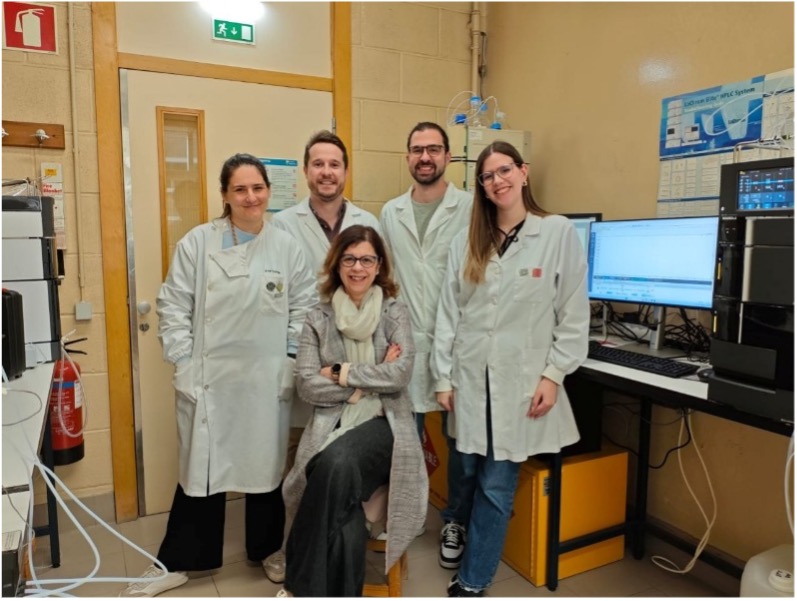
1. at Prof. Paula Gomes’s lab with some of her coworkers.

2. at the i3S, using the evaluation software for processing experimental SPR data.